Showing posts with label Business. Show all posts

Tuesday, 26 September 2017

Blog No Baap

Everything you need to know about SharePoint Add-Ins and the Sandbox Deprecation


What is and why use Sandbox Solution?
Microsoft had introduced SharePoint Sandbox Solutions for the first time in SharePoint 2010. Sandbox solutions enabled site collection users to upload their own custom solutions.

For those who do not have SharePoint Farm privileges, this solution proved to be very useful. All the user had to do was create/develop a Sandbox solution using Visual Studio, upload it to the solution gallery of the particular site collection and it was ready to use after activation.

Types of Sandbox solutions
Sandbox solutions are of two types namely code based and declarative (or NCSS) solutions.
Code based Sandbox Solutions

Code based Sandbox solutions are fully declarative solutions which contains server side code consisting of .net assembly file. This is the feature that Microsoft has recently deprecated.
Declarative Sandbox Solutions or NCSS

Declarative Sandbox solutions on the other hand, are those which have only HTML markup and JavaScript code. These are also known as No-Code Sandboxed Solutions (NCSS).

Announcement from Microsoft

Microsoft first announced the deprecation of code based sandbox solutions back in January 14, 2014. On July 29, 2016 they announced that they would completely remove code-based sandbox solutions by the end of the next month.

Ideally a sandbox solution is used to create workflows and web parts, feature receivers, list receivers. They are custom-coded and are hosted on the server-side. Deprecating code based sandbox solutions would prevent the following from working:
Event receivers
Feature receivers
Coded workflows would cease to work
Coded InfoPath would be rendered non-functional
Web parts created under Sandbox solutions

Click Here to Get 3 Days of Sharepoint Consulting FREE

Will Sandbox solutions be entirely disabled? How can we save our solutions?

Both types of Sandbox solutions are disabled if they have a .NET assembly file (.dll). By default, solutions created in Visual Studio 2015 and Visual Studio 2013 using Sandbox template create an assembly (.dll) files. However, for a fully declarative solution you will need to disable assembly from your solution.

Whereas the Code based solution is entirely disabled making it important to ensure you have a backup plan that can achieve similar functionality to replace them. The following methods can help you overcome the setback:
Use a JavaScript Object Model (JSOM) or SharePoint REST/ OData service calls.
Use a SharePoint Add-In Model (SharePoint Hosted, Provider Hosted) and Remote Event Receivers.

In short, all sandbox solutions will have to be migrated to No-code Sandbox Solution (NCSS).

How do you manage the situation? – Here’s what we can do for you.

We have been working on SharePoint for long and our developers make it a point to keep themselves up-to-date with the latest changes and features in both SharePoint and Office 365. We have already helped our existing clients to migrate from custom-code sandbox to no code base sandbox solution to overcome the deprecation issue.

Here’s how we conduct the transition.
We identify the sandbox solutions that have been deployed in your site collections by downloading it for each site collection and checking the archives using PowerShell.
We replace code based sandbox solution with JavaScript object models and/or creating SharePoint Add-ins (i.e. SharePoint Apps)

How our SharePoint consultants can help you?

If you haven’t migrated to cloud-based solutions yet or want to enquire about anything related to SharePoint, get in touch with us and we’ll help you out.

We have the best SharePoint experts in our team, who can understand your existing solution quickly and start working with minimum guidance on a solution for you.
Read More

Thursday, 21 September 2017

Blog No Baap

The economics of self-service checkouts


Gary Mortimer, Queensland University of Technology and Paula Dootson, Queensland University of Technology

Self-checkouts in supermarkets is increasing as businesses battle to reduce costs and increase service efficiency. But looking at the numbers, it isn’t clear that self-service is an easy win for businesses.

Self-checkouts aren’t necessarily faster than other checkouts, don’t result in lower staff numbers, and there are indirect costs such as theft, reduced customer satisfaction, and loyalty.

Worldwide, self-checkout terminals are projected to rise from 191,000 in 2013 to 325,000 by 2019. A survey of multiple countries found 90% of respondents had used self-checkouts, with Australia and Italy leading the way.

Employment in the Australian supermarket and grocery industry went down for the first time in 2015-16 and is projected to remain flat for a few years. But staff numbers are projected to rebound again, in part due to the need to curtail growing theft in self-checkouts.
Social trends pushing self-checkout

There are a couple of intertwining trends that explain the rise of self-checkouts.

We now visit our supermarkets more frequently than ever before, two to three times per week in fact. This means our basket contains fewer items and being able to wander up to a self-checkout, with little to no wait time, has been an expedient way to shop. Most shoppers consider self-checkouts both fast and easy to use. Although this varies with age – 90% of shoppers aged 18-39 found self-service checkouts easy to use, only 50% of those over 60 years said the same.

Shoppers also gain value from taking control of the transaction – being able to ring up their own goods and pack them the way they want. This is because a sense of control over their own shopping can lead to greater customer satisfaction and intent to use and reuse self-serve technology.
The numbers behind self-checkouts

Wages represent around 9.5% of supermarket revenue in Australia, and reducing wages is one of the reasons proposed for the uptake of self-checkout.

But from a business perspective, moving from “staffed” checkouts to self-serve machines isn’t cheap. A typical setup costs around US$125,000. On top of that, there are the costs of integrating the machines into the technology already in place – the software and other systems used to track inventory and sales, and the ongoing costs – to cover breakdowns and maintenance.

But the biggest direct cost to retailers of adopting self-service checkouts is theft. Retail crime in Australia costs the industry over A$4.5 billion each year.

There is the reason to believe that rates of theft are higher on self-service machines than regular checkouts. A study of 1 million transactions in the United Kingdom found losses incurred through self-service technology payment systems totaled 3.97% of the stock, compared to just 1.47% otherwise. Research shows that one of the drivers of this discrepancy is that everyday customers – those who would not normally steal by any other means – disproportionately steal at self-checkouts.

Studies also show that having a human presence around – in this case, employees in the self-checkout area increases the perceived risk of being caught, which reduces “consumer deviance”. This is why retailers have been adding staff to monitor customers, absorbing the additional losses, or passing them on to customers in an “honesty tax”.
Making self-checkouts work

As you can see in this graph, preliminary work by researchers Kate Letheren and Paula Dootson suggests people are less likely to steal from a human employee than an inanimate object. Not only because they will get caught, but because they feel bad about it.

On the other hand, consumers have plenty of justifications to excuse self-checkout theft, which is leading to its normalization.

To combat this, researcher Paula Dootson is trying to use design to combat deviance. One of the ways is through extreme-personalisation of service to reduce customer anonymity. Anonymity is an undesirable outcome of removing employees and replacing them with technology.

Other ideas are to include moral reminders prior to the opportunity to lie or steal (such as simply reminding people to be honest) and to humanize the machines by encoding human characteristics to trigger empathy.

While self-service technologies will continue to be adopted by businesses broadly, and particularly within the retail sector, it will be important for retailers to take a holistic approach to implementation and loss prevention.

Self-service technology reduces front line staffing costs and increases efficiency by re-distributing displaced staff into other service dominant areas of the business, but it creates unintended costs. These business costs can be direct, in the form of theft, but also indirect costs, like reduce customer satisfaction and loyalty. Something that some supermarkets are focusing on today.
Self-service technology reduces front line staffing costs and increases efficiency by re-distributing displaced staff into other service dominant areas of the business, but it creates unintended costs. These business costs can be direct, in the form of theft, but also indirect costs, like reduce customer satisfaction and loyalty. Something that some supermarkets are focusing on today.

Gary Mortimer, Associate Professor, Queensland University of Technology and Paula Dootson, Research Fellow; PwC Chair in Digital Economy, Queensland University of Technology
Read More

Tuesday, 15 August 2017

Blog No Baap

A Guide To Using Pinterest for Ecommerce Marketing

Every social networking website provides businesses an opportunity to get closer to their customers, boost engagement and increase sales. But specifically for e-commerce businesses and websites, Pinterest is by far the most effective social network.
If you’ve been ignoring Pinterest until now, here are a few stats to get you thinking.
  • Pinterest has more than 75 million registered users.
  • It ranks third, after Facebook and Twitter, in terms of generating daily referral traffic.
  • Almost 80% of its users are women.
  • Buyers referred from Pinterest are 10% more likely to buy your products.
  • Buyers are increasingly using Pinterest to find relevant products.
In short, Pinterest can play a huge role in your social commerce strategy. Not only can it send you thousands of qualified sales leads, it can also help you build a strong brand image.
Here’s how you can use Pinterest to strengthen your e-commerce marketing strategy.

Understand the Platform First

Although it has great e-commerce potential, Pinterest is still primarily a social network. So to find success, you need to reach out to your potential customers and people who might be interested in your products. The primary benefits you can get out of Pinterest are:
  • Engaging with your target audience and potential customers.
  • Increase visibility of your products.
  • Use the Pinterest audience to build your e-commerce business.
  • Get direct feedback from customers on products.
  • Improve your referral traffic.
Don’t expect direct sales though. Pinterest will work as an advocate for your products and send you referral traffic. But you cannot make direct sales on it.

Encourage Pinning on Your Website

Before promoting your products on Pinterest, create a strong case for it on your ecommerce website. This includes adding the “Pin” button on all your product pages and encouraging your website visitors to follow you on Pinterest. You can use social media sharing widgets like AddThis or DiggDigg to add the relevant social sharing buttons. You can also route members to your Pinterest page by announcing different competitions and special offers for Pinterest users on your website.

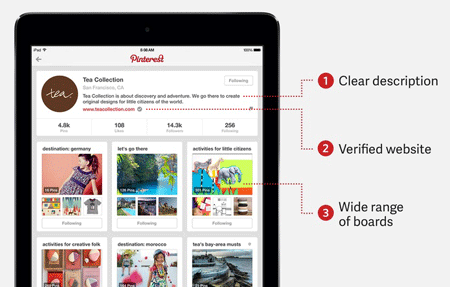
Create a Pinterest Business Page

pinterest-business-page-example
If you’re serious about using Pinterest to market your products then instead of using a Pinterest personal profile, create a Pinterest Business page. Pinterest Business profiles are specially designed for organizations who wish to engage with their customers. To get a verified Pinterest Business page, you just need to confirm your website address. This will add further credibility to your profile and also make you eligible for additional features that individual profiles don’t have.

Enable Rich Pins Greater For Engagement

Research indicates that Pins that include a price tag attract 30% more Likes on Pinterest. There are two ways of adding a price tag to your Pins. You can either add the price in the product description or you could enable Rich Pins. Similar to Twitter cards, Rich Pins is a great feature for e-commerce websites. It automatically picks up the price and stock details from your product page and displays it with your Pinterest posts. For detailed instructions on configuring Rich Pins, click here.

Attract and Engage Your Followers

To be successful on any social network, you need to attract followers and then keep them engaged. To attract followers on Pinterest, shortlist other more active Pinterest accounts that are pinning about similar products. Proactively engage with the followers of those accounts by responding to their comments and answering any questions that they have left on different images. Also, whenever someone RePins or Likes your images, send them a thank you message. These small things gradually increase your followers. You can also run special contests on Pinterest and ask your website visitors to participate.

Curate Content Intelligently

For a successful Pinterest strategy, you need to be an active content curator. Don’t just share your own product pictures. Rather, Pin images from other users with similar interests. But you need to do this intelligently. Instead of pinning images from your competitors, pin images of products or things that complement your products. For example, if you’re selling sports equipment, apparel and gear, you can pin pictures of different sports personalities, or international matches being played in different countries.
Pinning images from other users adds more variety to your Pinterest profile and also helps you create new relationships, which is crucial on any social network.

Organize Your Boards and Pins

To make it easy for your followers to explore different products, organize your images in different boards. Again, instead of focusing only on your products, create a combination of original and curated boards. Create separate boards for every product category and add pictures from your website. Then create boards containing pictures that show different usages of your products in real life. Or you can create boards that contain different statistics and facts about your products. The possibilities are endless. Just make sure your profile is well organized and easy to explore.

Use High Quality and Large Images

Pinterest is a visual social network. People click only on high quality images. Make sure all your product images and Pins are of the highest quality. Research also shows that taller and larger images get much more engagement as compared to smaller images. In general, images that are 738 pixels wide and 1128 pixels high appear the best.

Add Clear Calls To Action

Research shows that Pins that have clear calls to action in their description or image content, drive almost 80% more engagement. Since your primary objective with Pinterest is to drive traffic to your e-commerce website, you should always include clear calls to action in the image description. A call to action is a sign or statement asking the user to take a specific action. For example, “Click Here”, Download Now”, “Register Now” etc. To make it more compelling, use questions or statements that require a response from the user. Combine this with different calls to action to get the most out of your Pins.

Use Pinterest for SEO

Over time, Pinterest has proved to be a great source of referral traffic for websites because of its SEO strength. To get the maximum benefit from it, use descriptive names for your images and add descriptions with every Pin, along with the product URLs. Use the keywords that best describe your products. But avoid keyword stuffing. Using too many keywords can put people off, and reduce the engagement on your Pins. Create natural descriptions and image names with keywords where necessary.

Monitor Performance With Analytics

To monitor your progress on Pinterest and see which posts are getting the highest exposure, you can use the built-in Pinterest analytics. These statistics are only available to Pinterest Business users, so you’ll need to sign up for a business page. Analytics will show you the Pins with the highest reach, exposure, comments and likes. Plus, you’ll also get details about the demographic and geographic details of your followers.
Read More

Sunday, 13 August 2017

Blog No Baap

What is the Value of a Domain Name?

So, what is a domain name worth? The answer that I have to this question, largely goes against the mainstream conversation of valuating a domain. In fact, I don’t even think that the answer needs to be long and drawn out. It’s simple. Call it a cop out response, but the answer is simply: a domain name is worth any amount that a person is willing to pay for it.


Boring answer, but I feel it’s true. Sure, you can valuate an entire web site that the domain is attached to, and determine it’s approximate worth based on a number of parameters. For example, when determining the value of a web site, you can ask questions such as: what is it’s monthly ROI? How much time and energy needs to be expended to maintain that ROI? Is it trending in any specific direction? Is the content unique, allowing it a fair chance in Google organic search results? And so on…

And of course, many people ask questions about the domain name as well, which does strangely affect the value of the web site, or perhaps more accurately, the perceived value.
Factors That Can Potentially Hinder The Value Of A Domain Name

There are factors that can hinder the value of a domain name to be sure. If a domain name was ever used for pr0n, or caught up in any legal issues, most people don’t want any part of it. Thanks to the Wayback Machine (Internet Archive) we can see snapshots of the history of many web sites, to see if it was used in any way that may decrease it’s value.

Another factor that can make a domain less worthy is if there have been any manual spam assessments made towards it by Google, and perhaps other search engines.
A Lot Of Times, Value Is Really Just “Perceived” Anyway Isn’t It?

A common practice on web site selling sites like Flippa, is to buy a decent web site, attach what is referred to as a “premium” domain to it, and resell it, landing the clever seller who knows a little about DNS a cool profit. And if he’s a nice guy, he will also do the change of address in Google and Bing.

To me, for the most part, value is just “perceived” when it comes to domains. I know by default people value .tv domains higher than they do a .com, but that’s only because the powers-that-be made the default initial price for .tv domains much higher.

And there is still the lingering suggestion that the keywords in the domain name are important for SEO. Are they? Maybe see Google’s reaction to that to see for sure. Sure, we know the words in a URL can make a difference for SEO, but will the homepage rank higher because of the words in the domain name? It seems not so much these days, if at all.

Yes, a site about the raw food diet could probably do wonders for human’s benefit if that phrase were in the domain, because it will be semi-clear what the site is about by looking at the domain name. But, there has been a lot of spam sites created with high focus on keywords in the domain name, with other sites without such domains having more value in terms of content. Plus, what about clever branding, like a site about raw foods might be called: RawkItOut for a play on words. Should it not be given the same chance for homepage ranking?

I believe Google also values transparency, so there has been some suggestion that WhoIs protection on a domain can negatively impact SEO. I can’t say for sure the impact, but I will tell you that spam increases greatly by email and snail mail when you leave that protection off. So, what to do?
Does Domain Age Matter?

Also, people talk a lot about “age” for domain names. Why on Earth would that matter when it’s being sold in the marketplace? In fact, I feel that you have more work to do when buying an aged domain, because you have a history of possible mistakes that were made with it.

The only thing that I have heard of that makes any sort of sense when it comes to the age of a domain having value, is that when a web site owner pre-registers her domain for several years, it shows that she is serious about her site.

Sure, if she has run the site for several years prior, the content attached to the site may have higher value, but I don’t see older domains being of great value just because they are old. Age doesn’t make them wiser.

Aged sites… that makes sense to me. Aged domains, not so much.
Personal Beliefs Might Fluctuate (And Randomize) The “Value” Of A Domain Name

I think it boils down to what someone might think of your web site when hearing the domain name, whether it has value. And this is really based on personal beliefs. Let me list a few examples.

1) I hear a lot that a .net domain might be looked at as less than valuable, because it’s a cheap knock off to a .com.

2) When I told a friend my web site address, which has the TLD .xyz he thought that I was kidding and that can’t possibly be real. My girlfriend (future wife, woot!) refuses to register a .xyz because she doesn’t lend it any credibility. Tell that to Google, who registered abc.xyz. Good buy I say!

3) A .com does always seems cooler than any other TLD doesn’t it? I know several Canadian business owners who would prefer not to purchase the .ca and opt for the .com instead, because it is “more valuable”. Is it? I don’t know.

4) Plenty of people, primarily those that still want to see their keywords in the domain name, like the idea of hyphens in a domain, for when they can’t get the “right” one because someone else squatted on the version without the hyphens. So, do hyphen domains have value? Depends who you ask. Me, in the past would say no. It felt like a spammy choice. In fact, when I was looking for screencast software that was both cloud based, and that I could use offline, I tried several for more than a year without feeling happy about the choices. And, I always skipped past screencast-o-matic.com in the search results because I didn’t like the two hyphens. I was a hyphen snob. Well, let me tell you, for whatever reason, I decided to try their software, and I have been using it for 3 years, and I don’t want to shop around anymore. Perceived value of a domain made me overlook a great site/tool for so long.

5) Remember that social site profilactic.com? It’s a one word, real word, domain name and a .com to boot, 3 plusses for domain name value wouldn’t you say? Well, some people would be embarrassed to have a site with that name in their browser history. Kind of decreases the value a little, when used as a social site, I feel.

I know that I thought of more “perceived value” ideas when I was chilling in the bath tub, but now I forget, so I will move on.
Is There Any “Real” Value In A Domain Name Choice?

I guess my point of all of this is, if you believe for example, that a domain has more value because it is a golden oldie, and you pay more for it (or convince someone to buy yours), then it is more valuable. However, you won’t be able to sell me a .com for more than $12 just because it’s aged, unless it’s attached to a web site. Because I don’t feel that age has value in this case. It’s a matter of a opinion, one that premium domain sellers would love for you to buy into.

And, if you are holding on to the idea that using your target keyword in the domain name will bring you higher in search results, and you pay more for it, then it is more valuable (to you at least), but it’d be tough to measure your ROI.

To me, I think the value of a domain lies in what it is being used for, and if the intended audience will see it appropriate for the intended purpose.

There are areas that are pretty much undeniable true though. Things like:
A domain that is short and/or easy to remember probably has more value than the default price you could have bought it for from NameCheap or Godaddy, etc.
A domain name that matches, precisely, the intended purpose of the site it is attached to has more value.
Read More

Friday, 11 August 2017

Blog No Baap

What Is Customer Loyalty Worth?

Have you ever wondered what makes a customer loyal? Have you ever tried to create a loyalty program to manufacture a greater bond between your brand and your customers? One last question for ya. Does your loyalty program or ones that you’ve seen others offering, look more like bribe programs?


To a lot of retailers a customer retention strategy is commensurate to a loyalty program that offers financial rewards. Like any business, Retail marketers employ these rewards programs because consumers follow a predictable and measurable path to repeat purchases. CEOs and CFOs love predictable and measurable consumer behavior. However, we are seeing indicators that consumers are becoming increasingly dissatisfied by the similarity of these programs among the businesses which use them and their lack of compelling benefits. Here’s the thing. As we become accustomed to a higher level of service, which is a key differentiator for businesses, the client / consumer becomes accustomed to that level very quickly and it takes more to wow us. After all we are fickle and if the difference is just money, we will gladly switch our loyalties to rival companies which offer even bigger rewards.

Now the real secret to building even deeper connections with your customers is to follow the smartest retailers who have shifted their thinking of client loyalty not as a new or separate program but as a corporate strategy. Successful business marketers are insightful and empathetic to the marketplace. They put themselves in their customers’ shoes to fully understand their perspective and then serve those customers with genuine passion. These brands not only create customers, they create raving fans with enough emotional loyalty that they will act as brand advocates, ambassadors and promoters. These raving fans will go out of their way to spend more, pay premium prices from the brand even when other retailers and products are readily available.

Online merchants have the unique opportunity to nurture emotional loyalty by alleviating the pain points of traditional shopping and capitalizing on the strengths of digital e-commerce to deliver exceptional shopping convenience and personalization.

Customer Loyalty is Imperative to Business Survival

As more consumers live online rather than merely get online, there is a shrinking pool of new consumers for the online marketer to target. This obviously makes retaining your existing customers that much more important.

An internal study performed at Google shows that current consumers give little thought to moving from site to site to compare products and prices. They call this the zero moment of truth. As much as 88% of consumers are researching items online and then buying the items at a physical store. That figure is from Accenture, April 2014. The shopping decision cycle has lengthened as there is more information to research. As a result, consumers are more informed and they want a valid reason to remain loyal.

One way to keep me loyal is to have a great website that delivers what I want on the device I happen to be using at any given time. Google recently announced the heightened support and weight of “Responsive” Web Design or Mobile Friendly websites. This is in response to the trends that Google sees from the online community and their device usage. I see many marketers are still adjusting to this reality as well. Sadly, the blogs were all on fire about mobilegeddon rather than talking about how to use it to retain customers.

It really ticks me off actually. When I see a new promotion and it’s only for new customers and the only way to get any perks for my loyalty is when I complain and am ready to leave to another competitor. Now I am eligible for a great discount. Has that happened to you? When will businesses truly understand that loyalty programs that rely solely on price promotions do not drive true loyalty?

A study performed by the Center for Retail Management at Northwestern University illustrates the buying power of loyal customers. In the study, it states that 12% to 15% of consumers were loyal to a single retailer. What is fascinating is that those customers generated 55% to 70% of company sales. Does anyone remember the Pereto Principle? The 80/20 Rule?
Rewards vs Loyalty

As can be seen (hopefully) with rewards programs, customers may continue purchasing from you only as long as the reward is available to them to the point of diminishing returns.

As you have read countless articles and seen various whitepapers, you may come to the same understanding that consumers are capable of forming strong emotional bonds with brands, similar to how they feel for friends, relatives or loved ones. I know that I attend an event twice a year at a certain resort in Scottsdale and every time I drive by, I now have a warm heartfelt feeling come over me. It has nothing to do with the resort, however they are the secondary recipient of by loyalty as I will come back and spend money just to soak up the good feelings. I have the same level of loyalty to a couple of stores where I am treated practically like a member of the family rather than just a customer. If you think about it, I am sure you can picture a business you feel the same way about. You may find yourself even promoting that business to your friends enthusiastically.
Earning Authentic Loyalty

An authentic loyal customer is not created through a program delegated to a person in the marketing department. Rather, it needs to be a part of a company’s culture. It must be second nature and flowing like the lifeblood through the business’ operations and procedures.

So what can a retailer do that will generate the kind of energetic loyalty that many only dream of? Let’s take a look at a brand which is successful at this and follow their lead so we can have a better grasp of how they get customers to say No Thanks to competitors. 1st I can think of Apple. They have a culture that clearly nurtures strong loyalty to their brand. Apple made their products with simple designs that impact our lives and better yet, the products are easy to use and they work without a lot of hassle or need for added plug-ins or downloading extra drivers. Bottom line, it’s the product 1st. Start with a great product or service that delivers better than the competition. Next create an inclusive customer experience that creates a sense of belonging to something special that isn’t offered anywhere else.

What does that look like? As customers remain loyal, let’s say on the anniversary date, they can get entered into contests to win rewards. There can be customer chapters organized by geography with specific events just for each group strengthening the community as well as the bond with the brand. This goes beyond the old newsletter that I doubt gets much attention anymore as everyone’s email is overflowing with clutter as it is.

Another thing that will go a long way is to offer the same special discounts not just for new customers but also the loyal customers who have been loyal after a certain period of time.

That should get your creativity started on growing a loyal customer base. Tell me what you come up with for your company.
Read More

Wednesday, 9 August 2017

Blog No Baap

Why Is The Life Time Value of My Customers Important?

Have you ever watched Shark Tank? The thing they are the most critical of is an entrepreneur who doesn’t know their numbers. So you have customers. You have sales. You know the cost of acquisition for each new customer. You even know how much it costs to create the product or provide the service and how much profit is created from each sale.
It goes without saying that you want to be able to determine how many dollars you are getting back for every dollar you put into a marketing channel or campaign. That’s business 101. That’s cute. You may be effectively measuring ad spend against simply conversion rates, but you’re still missing which campaigns are bringing in your highest value customers; the ones who repeatedly come back again and purchase.
If you’re in business, You already know that the real money is in delivering enough value so that customers will buy from you again and again. In the big picture when you’re estimating value of a customer per conversion, you will factor in things like repeat business, referrals/word-of-mouth, and lifetime customer value. When marketing online, and using channels such as AdWords or Bing or Yahoo, factoring in these values can give you the flexibility to bid higher on keywords or devices or even geographic areas while confidently bidding below your value-per-click.

So what is Customer Lifetime Value?

Very simply it is the sum of all the purchases a customer makes with you. For example, if a customer only makes one purchase for $20, that customer’s CLV is $20. If a different customer makes eight purchases, and each of those are for $150. That customer’s CLV is $1200. Because there are huge differences between the customers who purchases once from you, and the customer who purchases multiple times, you want to know who they are.
Ask yourself: Why do you think repeat customers come back? Should they be treated differently? My answer is a resounding YES. Not only treat them exceptionally well, but determine the costs to get them and do what it takes to keep them.
When you think about it, this is a very powerful metric to use in identifying the marketing campaigns or even in store employee behaviors or interactions which are bringing in your very best customers. This also illustrates what turns a one-time customer into a repeat customer or raving fan.
If you’re measuring ROI using first transaction only, your metrics will be skewed by customers who made an expensive first purchase or campaigns that brought in more customers. Let’s take a look at a fictional landscaping company named Walter’s Landscaping to illustrate how this works. This may help you get a good grasp of the concept. This will be a typical small company with a small budget to work with. So the year is 2015 and Walter is a start-up and doesn’t want to compete directly against other landscapers by leaving cards on residential homes. He doesn’t have time for that either. Someone told him to go direct with an online go to market strategy. His salesperson and partner also has a challenge finding leads or cold calling so, Walter uses AdWords to drive traffic to his site and increase phone calls and “More Info” sign ups. He is using Search, Display, Youtube and Remarketing to get his brand message out to highly targeted audience so he can have more time doing money making activities.

What do the conversions look like?

One Time Conversion Value for Walter’s Landscaping. He wants more of the higher end landscape designing jobs, and the info for those jobs are below:
  • Average sale revenue: $2,000
  • Profit margin: 25%
  • Leads that convert to a contract: 15% (They need to work on their sales skills)
  • Value-per-conversion (single sale): $75 = ($2,000 * 25% * 15%)
Factoring in the power of referrals / introductions / word-of-mouth
Walter’s Landscaping has hard data which shows that for each customer they typically gain 25% in additional business through referrals /word-of-mouth (because they ALWAYS ask for introductions from customers). Here’s how we factor that in:
  • Value-per-lead (single sale): $75
  • Growth from referrals: 25%
  • Value per conversion (+referrals): $93.75 ($75 * 125%) – It’s 125 because it’s over and above rather than showing a loss of 25%…
Factoring in the life time value of a customer
Lastly, Walter’s Landscaping knows that each new customer makes repeat purchases worth approximately $5,000 in revenue over their lifetime. It’s easiest to factor this into initial deal value.
  • Average contract revenue: $2,000
  • Repeat business over lifetime: $5,000
  • Profit margin: 25%
  • Lifetime profit per customer: $1,750 ($2,000 + $5,000)*(25%)
Once we have the LPV, you can factor back in how many prospects convert to a contract and referral gains:
  • Lifetime profit-per-customer: $1,750
  • Leads that convert to a contract: 15%
  • Growth from referrals: 25%
  • Lifetime value-per-conversion: $328.12 ($1,750 * 15% * 125%)
So I could end the article here now that I answered the question of calculating the Lifetime Value of a Customer, and hopefully you know why it’s important. I want to dive deeper into the subject because very few businesses or marketers fully take the time to find this data, let alone capitalize on it. Here is a bonus:
How does this CLV information enable you to be more strategic with your bidding?
For the sake of the example, let’s say 5% of clicks on the ads convert to a lead. Here is the value per click:
  • Value-per-click (single sale): $3.75 ($75 * 5%)
  • Value-per-click (+referrals / assisted clicks): $4.68 ($93.75* 5%)
  • Value-per-click (lifetime): $16.40 ($328.132* 5%)

Choosing your conversion value

Naturally, you want to use a calculation method that makes the most sense for your business and advertising and marketing objectives. Single sale conversion values can be useful when you want to maximize the immediate profit and know your customer acquisition cost. The Lifetime conversion values though can be even more valuable and useful because ultimately, you want to maximize long term growth of your business, right? When selecting and calculating a conversion value, it’s important to select the method that best aligns with your KPI’s or desired outcomes, such as a sale; which is really the only outcome that should matter for a business at the end of the day.
Once you are driving traffic and that traffic is converting to leads, you want to make sure those leads are converting to customers. This is where you determine the value of your leads and the value of your offer on your website or the skill of your sales team.
Sure you want to optimize the landing page with a strong and engaging call to action and content that is relevant to the keywords and the ad text. If your conversion metric is calls though, you want to make sure your attracting qualified leads and have skilled sales people to close the deal when they are called.
Measuring the campaign’s return on investment using the Customer Lifetime Value will take a little more energy and upfront work on your part, but does it make sense to know for sure that your optimization efforts will actually turn into positive business results rather than higher Click Through Rates (CTR) or Call rates which ultimately don’t turn into sales?
Read More